

A busy restaurant closes after a long evening. The servers clock out, the bar team finishes its shift, and the final customer payments are processed.
For customers, the transaction is complete.
For payroll, another process is just beginning.
How many hours did each employee work? Which employees participate in the gratuity scheme? How should gratuities be distributed? Does the amount recorded in payroll match the scheme? Can HR explain the calculation if an employee has a question?
For Cayman restaurants, hotels, resorts, bars, and other service businesses, gratuity is not simply an amount added to a customer bill. It connects employee hours, scheme rules, payroll calculations, distribution records, and reporting.
That is why gratuity management software has a practical role. It can help businesses create a clearer path from the hours an employee works to the gratuity information eventually recorded in payroll.
And that brings us to the question in the title:
Is Cayman service pay clear?
The rules can be clear. The operational process behind them is where businesses need to pay close attention.
First, What Does Cayman Require in 2026?
The Cayman Islands Government announced that from January 1, 2026, the general National Minimum Basic Wage increased to CI$8.75 per hour gross.
For service employees, the special gratuity calculation does not automatically apply simply because the employee works in hospitality or receives tips.
The official DLP guidance says it applies to service employees working for an employer with a registered gratuities scheme approved in writing by the Director of the Department of Labour and Pensions.
Under the DLP guidance:
- General National Minimum Basic Wage: CI$8.75/hour
- Maximum portion counted from gratuities: 25%, or CI$2.19/hour
- Minimum regular wage for the qualifying service-employee category: CI$6.56/hour
- Employee entitlement: Employees retain all gratuities earned.
This distinction is important when configuring hospitality payroll software.
A company should not simply create a "service employee" payroll category and assume CI$6.56 applies to everyone in it.
The approved gratuity scheme matters for every business.
In fact, DLP publishes a list of establishments with approved gratuity schemes and states that the list is updated monthly to reflect subsequent approvals. The latest publication listed on the DLP site is dated August 21, 2026.
That makes scheme status something Cayman service businesses should treat as a real payroll configuration requirement, not an assumption.
Visit the Official Cayman Island Demand of Labour And Pension Minimum Wage for more information.
What Is Gratuity Management Software?
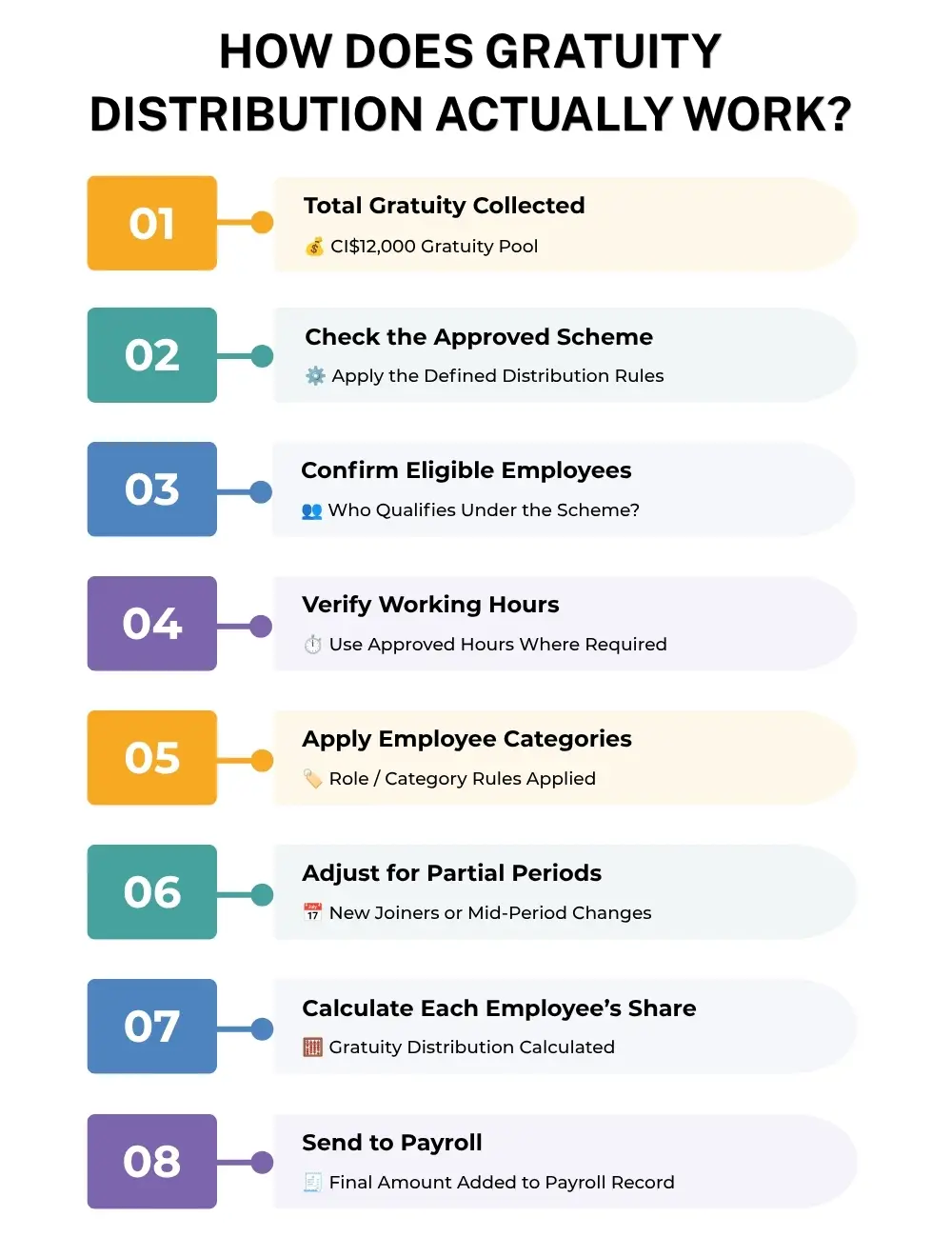
Gratuity management software helps a business configure, calculate, record, distribute, and report employee gratuities according to its defined scheme.
Think of the process as a connected chain:
Employee works → Hours are recorded → Scheme rules are applied → Gratuity is calculated → Payroll is processed → Records are reported
If one part of that chain is disconnected, payroll teams may need to fill the gap manually.
For example, attendance may be maintained in one system, gratuity distribution in a spreadsheet, employee information somewhere else, and payroll in another application.
The final amount may still be calculated but answering how that amount was reached becomes much harder.
This is where gratuity distribution software can help create a more consistent process.
Starting Point Is Not Gratuity. It Is the Employee.
Before calculating anything, HR needs to know who is participating in the applicable scheme.
Not every employee in a service business necessarily has the same role, working pattern, or gratuity treatment. A hotel, for example, could have employees working across:
- Food and beverage
- Housekeeping
- Front office
- Guest services
- Kitchen operations
- Maintenance
- Administration
- Management
Employee Information gives payroll a starting point.
- Who is the employee?
- Which department do they belong to?
- What is their employment status?
- What pay information applies?
- Are they included in the relevant gratuity arrangement?
When hospitality payroll software connects employee information with payroll and gratuity configuration, HR does not need to rebuild this context every pay cycle.
Then Come the Hours
This is where gratuity management becomes closely connected with attendance.
Imagine three employees:
Anna: 42 hours
David: 36 hours
Michael: 28 hours
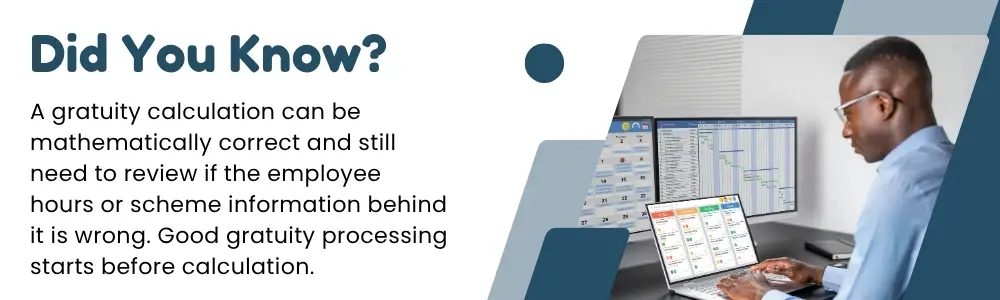
If working hours form part of the employer's approved distribution method, accurate time records become important to the employee gratuity calculation.
Now suppose David actually worked 40 hours, but four hours are missing from his timesheet. That is no longer an attendance problem. If those hours affect the applicable distribution calculation, the gratuity result may also need correction.
This is why Attendance and Timesheets should connect with gratuity management software rather than forcing payroll teams to repeatedly copy hours from one file into another.
The better the input, the easier it becomes to trust the calculation.
The Scheme Is the Rulebook
Once employee and time information is ready, the next question is: What does the employer's approved scheme require?
This is where businesses need to avoid treating service charge management software as a magic calculator. Software should not invent the rules. The business first needs a clearly defined and applicable gratuity arrangement. The system can then be configured around that process. Depending on the scheme, payroll may need to understand:
- Which employees participate
- Which gratuities enter the applicable pool
- How distribution is determined
- Whether eligible hours affect distribution
- How different employee categories are treated
- How joining or leaving during a period is handled
- How absences affect the process
- When gratuities are processed
- What supporting records should be retained
The Cayman gratuity scheme therefore needs to be understood before automation begins. The wrong formula processed automatically is still a wrong formula.
Service Charges Need Clear Internal Treatment Too
A bill may include a service charge. Different business arrangements may determine how those amounts are handled.
HR and payroll should not casually treat every amount collected from customers as interchangeable. Service charge management software can help maintain operational records, but the business still needs to understand how its charges and gratuities are treated under its applicable arrangements and Cayman requirements.
For payroll & compliance, clarity is more useful than assumptions. They should know which amount is being processed, why it is being processed, which employees it relates to, and which rule has been applied.
Why Payroll Needs the Calculation Trail
Consider two payroll records. The first says:
Employee: Maria
Gratuity: CI$385
The second can establish:
Employee: Maria
Pay period: August 1–15
Approved hours: Recorded
Applicable scheme/category: Recorded
Gratuity calculation: Processed
Final gratuity amount: CI$385
Both ultimately contain CI$385.
But the second gives payroll much more context. This is where hospitality payroll software becomes valuable when connected with gratuity processing. Payroll should not only receive the final number. Authorized teams should be able to understand the information that produced it. That becomes especially useful when employees ask questions or when payroll needs to investigate a correction.
Attendance Should Be Final Before Distribution
Timing matters too.
Suppose payroll completes its gratuity calculations on Monday.
On Tuesday, a supervisor reports that several hours from the previous week were missing. If those hours are relevant to the distribution method, payroll may now need to revisit the calculation. A cleaner process is:
- Attendance recorded
- Timesheets reviewed
- Corrections completed
- Hours approved
- Gratuity calculation processed
- Payroll finalized
This creates a natural cut-off before gratuity distribution software processes the final data. It also shows why gratuity management cannot be treated as an isolated payroll feature. What happens earlier in the HR process can affect what happens later.
What About Employees Who Join or Leave Mid-Period?
This is another area where manual processing can become difficult. A busy hospitality business may regularly have employees joining, transferring, changing schedules, or leaving. Suppose an employee joins halfway through a gratuity period.
Another employee leaves three days before it ends.
A third employee moves into another participating role.
How should each situation be handled?
The answer should come from the business's applicable Cayman gratuity scheme, not from an improvised spreadsheet decision. Once the rules are established, gratuity management software can help payroll apply the configured process more consistently. Employee Information becomes particularly useful here because employment changes remain connected to the individual rather than existing only inside a gratuity worksheet.
What Should Gratuity Management Software Do?
Good gratuity management software should help connect the process rather than simply automate one formula.
- Employee Information: Maintain the employee details required for the applicable payroll and gratuity process.
- Attendance and Timesheets: Keep approved hours available where time affects the configured scheme.
- Gratuity Configuration: Allow the employer to maintain its applicable rules based on its approved arrangement.
- Distribution Processing: Use gratuity distribution software to apply the configured method consistently across relevant employees.
- Payroll Connection: Bring the calculated gratuity information into the employee's payroll process.
- Reporting: Maintain historical information for authorized HR, payroll, and management users.
- Audit Logs: Provide visibility into relevant system changes and processing history.
Together, these areas make hospitality payroll software much more useful for a service business than a stand-alone gratuity spreadsheet.
So, Is Cayman Service Pay Clear?
The government framework provides the starting rules.
But clarity inside the business depends on what happens after those rules are understood.
- Can the employer identify the right employees?
- Are working hours accurate?
- Is the approved scheme reflected correctly?
- Can payroll follow the employee gratuity calculation?
- Can employees' questions be answered?
- Can management retrieve reports?
- Can changes be traced?
That is where service pay becomes either clear or confusing. For Cayman service businesses, service charge management software and gratuity tools should help connect those pieces rather than create another separate payroll process.
The objective is not simply to calculate faster. It is to make the path from hours to gratuity to payroll easier to follow.
Make Every Gratuity Easier to Trace
A restaurant may process hundreds of shifts in a month. A resort may manage employees across several departments. A hotel may handle changing schedules, attendance corrections, new employees, and gratuity distributions within the same payroll period.
Those moving parts should not require a collection of disconnected spreadsheets.
HR HUB Pro brings Payroll, Attendance, Timesheets, Gratuity Configuration, Employee Information, Reports, and Audit Logs together to help Cayman service businesses maintain a clearer gratuity process.
Record the employee. Confirm the time. Apply the configured scheme. Process the gratuity. Connect with payroll. Keep the history available.
Because the best gratuity management software does not just tell payroll what an employee received. It helps payroll understand how the amount got there.