

A hotel group operates properties in the Cayman Islands, Barbados, and Trinidad and Tobago. All three properties hire international employees. First, the process appears to be similar.
- Find the right person.
- Make an employment offer.
- Collect their documents.
- Apply for permission to work.
- Wait for approval.
- Bring the employee on board.
But the closer HR looks, the more complicated it becomes.
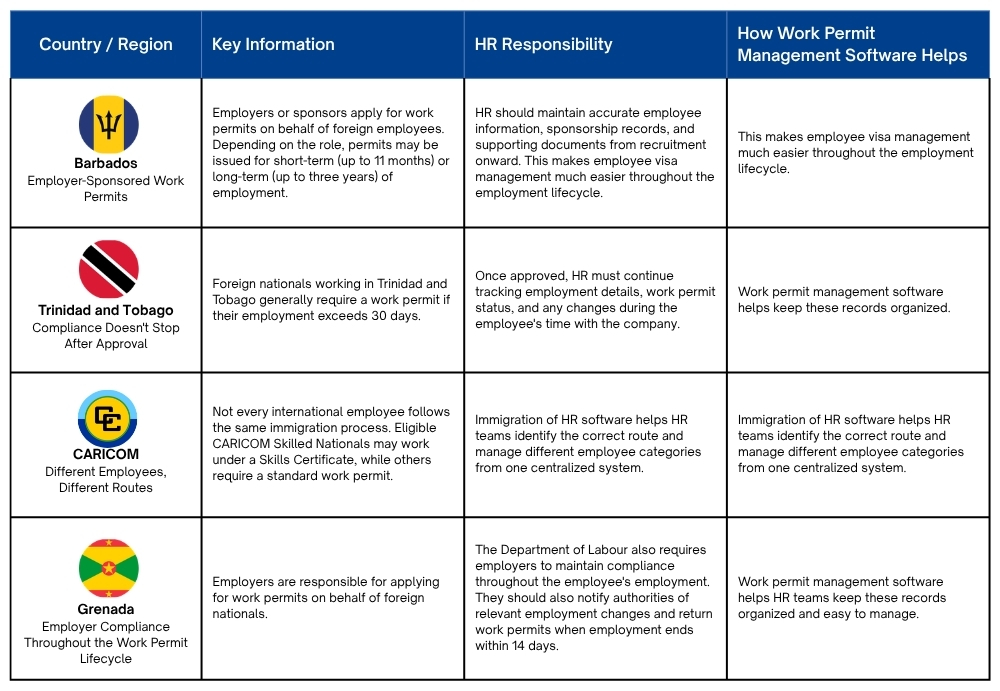
The Cayman property needs to follow local job-advertising and work-permit rules. The Barbados operation needs the employer to sponsor a short-term or long-term permit.
The Trinidad and Tobago business needs to use an online work-permit process and consider whether the foreign employee will work for more than 30 days.
A CARICOM national may qualify under a regional free-movement route instead of the standard work-permit process, depending on nationality, destination, and eligibility category.
This is the first fact every Caribbean employer needs to understand: no single Caribbean work-permit system.
Each jurisdiction applies its own immigration laws, government procedures, employment protections, supporting-document requirements, fees, and approval conditions.
For HR teams, this makes managing expatriate employees far more complicated than uploading a permit and recording an expiry date.
The company must know which legal route applies, which employer sponsored by the employee, which role was approved, where the employee is permitted to work, what happens when employment changes, and what needs to happen when the employee leaves.
This is where Immigration HR software becomes useful.
It gives businesses a controlled place to manage different permit routes and the employment information connected with them, without treating every international employee as if they follow the same rules.
Work Permit Usually Belongs to a Specific Employment Situation
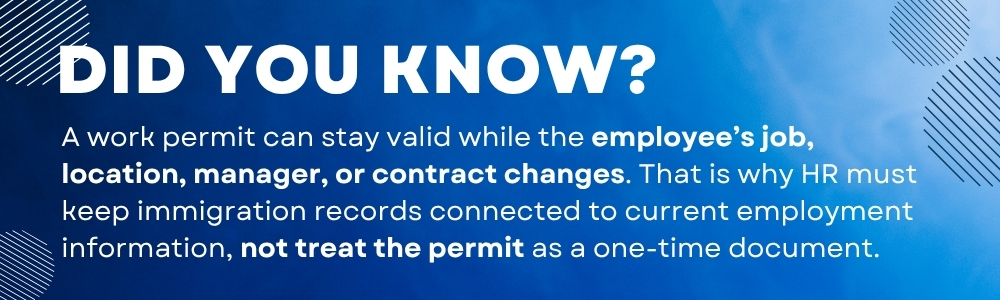
A work permit is not always a general license allowing an employee to work wherever they choose. It is commonly connected to facts such as:
- The sponsoring employer
- The approved job
- The work location
- The employee’s immigration category
- The permit period
Conditions imposed by the relevant authority That matters because employee information changes during employment.
- The chef becomes a restaurant manager.
- A nurse moves to another healthcare facility.
- An engineer transfers to a different project.
- A company restructuring department.
- An employee moves from one branch to another.
HR may see these as routine workforce changes. Immigration authorities may require the employer to review whether the existing permission still supports the new arrangement.
Good work permit management software should therefore connect the approved immigration position with the employee’s current job information.
Otherwise, HR may update the promotion in the HR system while leaving the immigration record unchanged in a separate spreadsheet.
What Is Immigration HR Software?
Immigration HR Software is a specialized HR solution that helps organizations manage the employment and work permit lifecycle of international employees.
Rather than storing immigration records in different folders or relying on manual reminders, the software centralizes everything into a single employee profile. This may include:
- Work permit information
- Immigration status
- Government approvals
- Passport information
- Visa information
- Employment details
- Supporting documents
- Renewal workflow
- Approval history
- Immigration records
The biggest advantage is visibility. Instead of asking, "Where did we save that approval?" HR already knows where to find it.
Instead of wondering which employee has an active permit, HR can see the status immediately. Good work permit management software helps organizations stay organized throughout the employee's journey rather than reacting only when action becomes urgent.
Cayman Islands: Local Recruitment and Employer Responsibilities Matter
The Cayman Islands has an active work-permit framework administered through Workforce Opportunities and Residency Cayman, commonly known as WORC.
Current Cayman government guidance reflects a strong connection between immigration administration and access to employment for Caymanians.
Under changes effective from 1 May 2026, vacancies supporting new work-permit applications generally need to be advertised for 21 days on the WORC electronic jobs portal and through prescribed local media, subject to applicable exemptions and rules. Existing valid work permits remain valid until they expire, while newer rules apply when subsequent applications or renewals are made.
To know more about the recent changes: Immigration Work Permit Reforms
The 2026 reforms also introduced notable employer and employee obligations.
One of the biggest changes affects employee mobility. Under the updated rules, many work permit holders cannot change employers during the first 2 years after their permit is granted.
If they leave earlier, they may be required to leave the Cayman Islands for at least one year before another employer can apply for a new work permit, unless they qualify for specific exemptions.
For HR teams, this makes accurate employment records and timely workforce planning even more important.
Read more: Barbados Immigration Department
Law Is Local, HR Software Record Should Be Central.
The Cayman Islands, Barbados, and Trinidad and Tobago do not apply identical work-permit rules. Yet the employer records behind those rules often have similar building blocks:
- Employee identity.
- Nationality.
- Sponsoring company.
- Job title.
- Location.
- Government route.
- Application status.
- Approved period.
- Supporting records.
- Employment changes.
- Renewals.
- End-of-employment actions.
This is where immigration document management becomes more than uploading passports and permit copies. Each file needs to remain connected to the correct employee, jurisdiction, application, employment role, and stage of the immigration lifecycle. When HR manages several islands or business entities, one central system can provide consistency while still allowing jurisdiction-specific processes.
Turning Work-Permit Rules into a Manageable HR Process
Knowing the law is one challenge. Turning it into daily HR work is another.
A policy may say the employer must advertise a position locally, government website may require an employer-sponsored application, permit may be tied to a specific role.
An authority may need to be notified when employment ends. Someone inside the company still needs to make sure each action happens. That responsibility usually falls across HR, recruitment, management, legal, finance, and payroll. Without a system, the process becomes a chain of questions:
- Did recruitment keep the advertisement?
- Has the manager confirmed the job description?
- Which company is sponsoring the employee?
- Has the permit been approved?
- Can onboarding begin?
- Was the employee’s location changed?
- Is the renewal being prepared?
- Has the authority been notified about the exit?
This is why Immigration HR software should not be designed as an electronic filing cabinet. It should help turn immigration obligations into assigned actions and visible statuses.
Why Employee Visa Management Should Be Connected to HR
One common mistake organization makes is managing employee visa management outside their HR system.
- Immigration records stay in one folder.
- Employee records stay in another place.
- Payroll works somewhere else.
This separation creates unnecessary duplication. A change made in one place often needs to be repeated somewhere else.
That increases the risk of inconsistency. A better approach is connecting immigration with the employee profile itself.
When HR updates the employee department, reporting manager, or employment information, the relevant immigration records stay linked to that profile.
Everything becomes easier to review because HR no longer needs to search across different systems. The employee has one profile, and organization has one source of truth.
Build the Immigration Record Before the Employee Joins
The strongest compliance process begins during recruitment.
Before an offer becomes an active international hire, HR should capture the jurisdiction, proposed role, employing entity, immigration route, and application responsibilities. For example, the system may record that:
- The Cayman role requires local advertising before a work-permit application
- The Barbados employer is acting as sponsor
- The Trinidad and Tobago employee needs a permit because the assignment exceeds 30 days
- The CARICOM national is applying under a recognized skilled category
This allows immigration compliance software to reflect the actual hiring route rather than creating a generic employee record after approval.
Close the Immigration Record When Employment Ends
Offboarding an expatriate employee may create immigration actions that do not apply to local employees.
The employer may need to notify the relevant authority, cancel or update a permit, record the employee’s final working date, and preserve the application and decision history.
Cayman’s current guidance, for example, requires employers to notify WORC within seven days after a work-permit holder’s employment ends.
This is why the immigration module should connect with the employee lifecycle. When HR records an exit, the system should trigger the applicable immigration review rather than assuming the work-permit responsibility ended automatically.
What HR HUB Should Help Caribbean Employers See
HR HUB’s Immigration Management, Employee Information, Document Management, and Notifications can help businesses build one view of the expatriate workforce. Authorized HR users should be able to see:
- Immigration route by employee
- Sponsoring entity
- Jurisdiction
- Application and approval status
- Supporting records
- Approved employment information
- Renewal workflow
- Employment changes
- Immigration history
- Pending HR actions
HR HUB streamlines immigration document management, ensuring supporting files stay connected to the event they belong to. With employee visa management, different authorization routes remain clearly distinguishable. Furthermore, HR HUB's integrated notifications and workflows ensure the right person is aware when an action is waiting.
Frequently Asked Questions
1. Is there one work permit law for the entire Caribbean?
No. Each jurisdiction has its own immigration laws, agencies, procedures, fees, permit categories, and employer responsibilities. CARICOM free-movement arrangements may offer a different route for eligible nationals in participating states.
2. Can an employee begin work while the application is being processed?
That depends on the jurisdiction and the permission held. Employers should confirm the applicable government rules before allowing a foreign national to begin work. A pending application should not automatically be treated as permission to work.
3. Who usually applies for the work permit?
In many Caribbean jurisdictions, employers or sponsors have a major role. Barbados explicitly places responsibility for the application on the employer or sponsor, while Trinidad and Tobago provides routes for employers applying for foreign staff.
4. Does a promotion or transfer affect a work permit?
It may. Because permits can be connected to the employer, occupation, location, or approved conditions, HR should review employment changes against the applicable immigration requirements before finalizing them.
5. Do CARICOM nationals always work without permits?
No. Free movement depends on the participating states, the employee’s nationality, and the applicable mobility category. A person who does not qualify under the relevant CARICOM route may still need a standard work permit.