
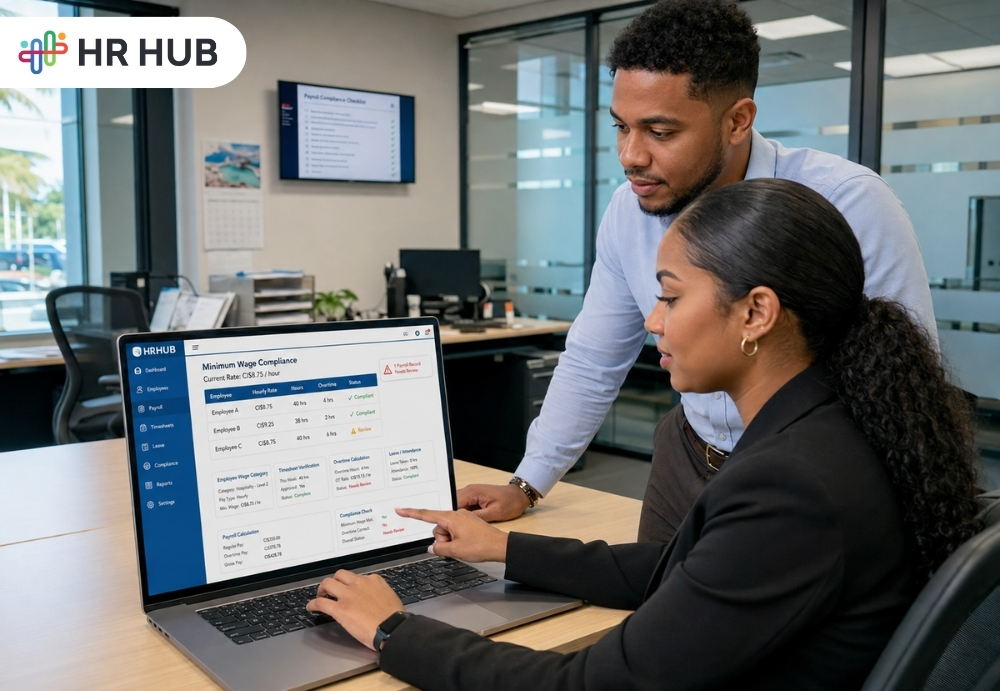
The Cayman Islands National Minimum Basic Wage moved from CI$6.00 to CI$8.75 per hour, the first change since the minimum wage was introduced in 2016. For employers, particularly restaurants, hotels, resorts, retailers, cleaning companies, property services, and other businesses with hourly employees, the change created a practical question:
Was payroll actually ready?
Changing one wage figure sounds simple. Payroll may also depend on employee categories, working hours, overtime, salary structures, timesheets, leave, and special wage calculations.
An employee can have the correct hourly rate in their profile and still receive an incorrect payment if their hours are wrong. An overtime formula can still be outdated. A monthly salary can look reasonable until its hourly equivalent is calculated. An employee can also be assigned to the wrong wage category.
This is where minimum wage compliance software becomes relevant. The purpose is not simply to store CI$8.75 somewhere in payroll. It is to help businesses connect the wage rule with the employee and working-time information that determines what should actually be paid.
So, is Cayman payroll ready?
The answer depends on whether businesses updated more than the headline rate.
What Changed With the Cayman Islands Minimum Wage in 2026?
The Cayman Islands Government confirmed that the National Minimum Basic Wage increased to CI$8.75 per hour gross from January 1, 2026. The amendment was formally made through the Labor (National Minimum Basic Wage) (Amendment) Order, 2025. The Department of Labor and Pensions also identifies special calculations for certain categories:
- Service employees working for an employer with an applicable registered and approved gratuities scheme
- Live-in household domestic employees
- Employees working on a commission basis
For qualifying service employees under an approved gratuities scheme, the regular wage component may be CI$6.56 per hour under the applicable rules. Since gratuity has its own calculation and scheme requirements, businesses should manage that separately rather than treating CI$6.56 as a general hospitality wage.
For live-in household domestic employees, up to 25% of the minimum wage, a maximum of CI$2.19 per hour, may be credited for accommodation and utilities. Commission-based employees also have a special calculation under which no more than 25% of the minimum wage may be counted from the earned commission.
For full legal guidance, businesses should refer directly to the Cayman Islands Department of Labor and Pensions for minimum wage information.
For payroll teams, the message is straightforward: The Cayman Islands minimum wage is not simply one number that can be applied blindly to every employee record. The correct employee category matters too.
What Is Minimum Wage Compliance Software?
Minimum wage compliance software helps employers configure wage rules and connect them with employee information, attendance, timesheets, salary components, overtime, and payroll processing.
Consider what payroll needs before calculating an employee's pay:
- Who is the employee?
- Which wage rule applies?
- How many regular hours were worked?
- Were overtime hours worked?
- What salary components apply?
- What should payroll calculate?
- Can HR review the result later?
When these pieces live in separate spreadsheets and systems, HR becomes responsible for moving information manually between them.
Payroll compliance software can make connections easier to manage. The goal is not to replace payroll judgment or Cayman labor requirements. It is to give payroll teams a clearer structure for applying the rules they have configured.
Updating CI$6.00 to CI$8.75 Was Only Step One
Imagine a service business with 150 employees. Payroll updates its standard hourly wage. Done? Not quite. HR should still ask:
- Are any employees currently below the new rate?
- Are salaried employees' hourly equivalents compliant?
- Which employees fall into special categories?
- Are overtime calculations using the correct normal hourly rate?
- Are old salary templates still being used?
- Are new employee records using updated wage configurations?
- Are attendance and timesheet records feeding the correct hours into payroll?
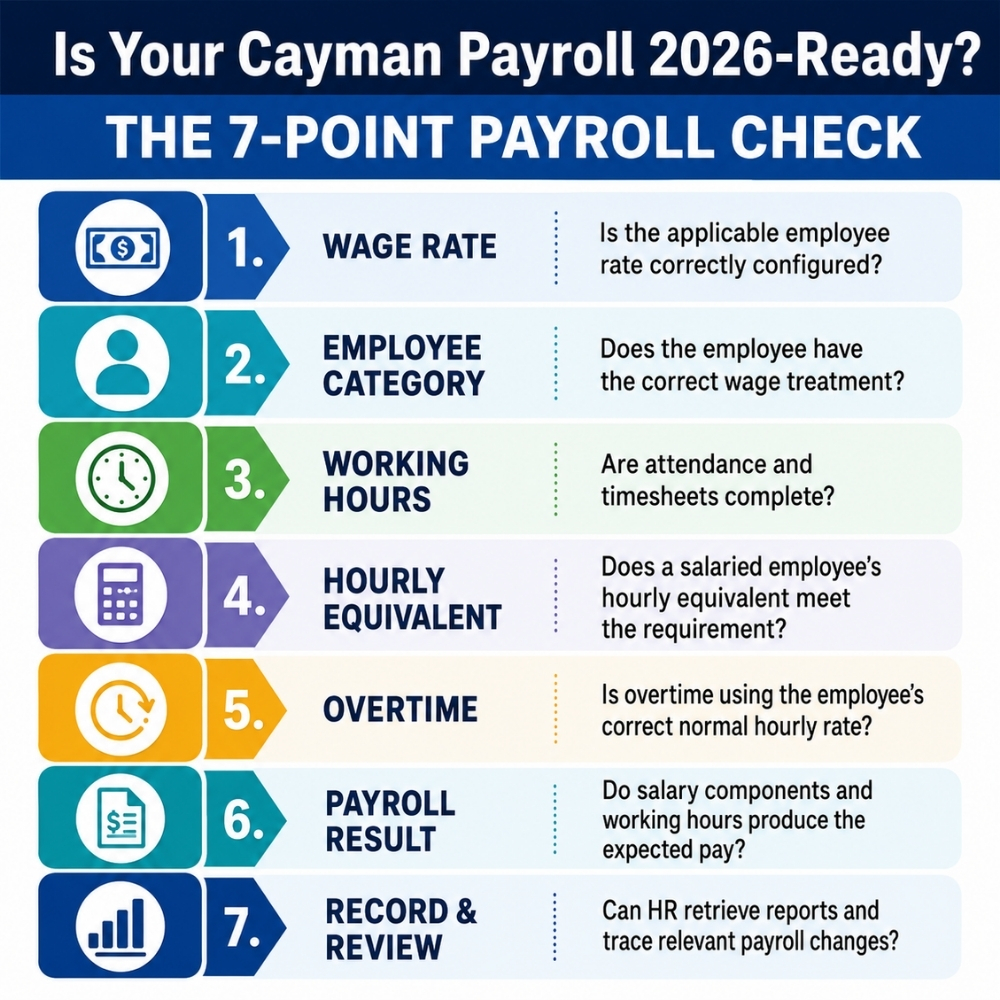
This is why Cayman payroll compliance needs to be treated as a process rather than a one-time rate update. A good payroll review moves through the entire calculation chain.
Do Not Assume Salaried Employees Are Automatically Covered
Minimum wage checks are not only for employees whose contracts display an hourly rate. The DLP provides guidance for calculating the hourly equivalent of a monthly salary:
Monthly gross salary × 12
Divided by
Normal weekly hours × 52
The resulting hourly rate must meet the applicable minimum wage requirement. Consider an employee working normal weekly hours but paying a monthly salary. The salary figure alone does not answer the minimum wage question. Payroll needs the relationship between salary and normal working hours.
This is an area where minimum wage compliance software can support HR by keeping salary information and working-time records within a more connected payroll process.
Attendance Is Part of the Wage Calculation
Payroll starts with time. Suppose an employee's hourly rate is configured correctly at CI$8.75.
Their attendance record shows 40 hours.
But they actually worked 46 hours.
The wage rate is correct.
The payroll input is not.
For hourly employees, attendance and timesheets give minimum wage payroll software the working-time information required for calculation. That means payroll readiness depends partly on what happens before payroll begins.
- Were all shifts recorded?
- Were missing punches corrected?
- Were timesheets approved?
- Were additional hours identified correctly?
- Was the final attendance period locked before payroll processing?
A wage system cannot correct working hours it never received.
Overtime Is Where the New Rate Becomes Even More Important
The DLP states that overtime is calculated at one-and-a-half times an employee's normal hourly rate. For an employee earning CI$8.75 per hour:
CI$8.75 × 1.5 = CI$13.125
The DLP presents the minimum overtime rate as CI$13.13 per hour.
If the employee normally earns CI$17.00 per hour, overtime would be calculated from CI$17.00 rather than the statutory minimum:
CI$17.00 × 1.5 = CI$25.50 per hour.
This is exactly why overtime calculation software should work from the employee's applicable normal hourly rate rather than relying on a fixed overtime amount entered years ago.
There is also a working-time trigger to consider. Cayman DLP guidance identifies the standard workday as 9 hours and the standard workweek as 45 hours, with overtime payable for work beyond the standard day or week, subject to the Labor Act provisions.
So, payroll needs two pieces of information:
How many hours worked?
AND
What normal hourly rates apply?
Salary Components Need a Review Too
Payroll is rarely just: Hours × Rate = Pay
Employees may have different earnings and salary components configured in the system.
That means a 2026 payroll review should also look at how those components interact with the employee's basic wage and applicable payroll rules. Businesses should identify which components form part of the employee's wage structure, how they are treated, and whether any old configuration was based on the previous rate.
Payroll compliance software can help maintain these components systematically, but HR still needs to verify that the configuration reflects the company's actual payroll rules and Cayman requirements.
This is particularly important when templates are reused. If a company hires a new employee in August 2026 using a salary template created in 2025, what values does that template contain?
Old payroll configurations can survive long after the law changes if nobody reviews them.
Special Employee Categories Need Their Own Rules
The 2026 change makes employee classification particularly important.
Service Employees Under Approved Gratuity Schemes
These employees have a specific calculation under the Cayman minimum-wage framework. This article will not go deeply into gratuity distribution because that process deserves its own review. For payroll purposes, businesses should simply avoid applying the service-employee calculation to every hospitality worker automatically. The applicable approved scheme matters.
Live-In Household Domestic Employees
DLP guidance permits a limited in-kind credit for accommodation and utilities under the special calculation for this category.
That means minimum wage payroll software may need a distinct configuration rather than treating the employee like a standard hourly worker.
Commission-Based Employees
Commission-based employees also have a special calculation, with limits on how much earned commission may be counted toward the minimum wage requirement.
Again, classification matters. A single payroll rule called "Minimum Wage Employee" may not be enough for every scenario.
Leave Pay Should Not Be Forgotten
One area businesses can easily overlook is paid leave. The DLP's minimum-wage FAQ states that workers, including service staff, live-in domestic helpers, and commission-based employees, must receive at least the National Minimum Basic Wage when on applicable leave such as sick, vacation, or maternity leave.
That means Cayman payroll compliance should not be checked only against days an employee physically works. Businesses also need to review how relevant paid leave enters payroll.
If the regular wage configuration was updated but an old leave-pay configuration still references an outdated rate, payroll can produce an inconsistency.
This is another reason payroll configuration should be reviewed as a connected system.
What Should Minimum Wage Compliance Software Actually Do?
Good minimum wage compliance software should connect the data behind the calculation.
Maintain Employee Wage Information
Payroll should know which employee and wage configuration it is processing.
Connect Attendance and Timesheets
Approved working hours should be available before payroll calculations begin.
Support Employee Categories
Different wage treatments should be configurable where applicable.
Maintain Salary Components
Payroll teams should be able to manage the components used in the employee's pay structure.
Calculate Overtime From the Applicable Rate
Overtime calculation software should use the correct normal hourly rate and approved working-time information according to the configured rules.
Support Payroll Review
Minimum wage payroll software should make it easier to identify records that require attention before payroll is finalized.
Provide Reports and Analytics
HR should be able to review payroll information across the workforce rather than employee by employee.
Maintain Audit History
Authorized users should be able to review relevant system changes when investigating payroll questions.
The software provides structure. The employer remains responsible for understanding and following the applicable legal requirements.
Make the Wage Change Work Beyond the Rate Field
The 2026 minimum wage change gave Cayman businesses a clear number to update.
But payroll does not operate through one number.
It operates through people, hours, rates, employee categories, overtime, salary components, leave, reports, and payroll records.
HR HUB Pro connects Payroll, Attendance, Timesheets, Employee Information, Salary Components, Overtime Configuration, Reports & Analytics, and Audit Logs to help businesses maintain a clearer payroll process.
Configure the employee correctly, bring approved hours into payroll, apply the right wage and overtime rules, review of exceptions and keep the calculation history available.
Because minimum wage compliance software should do more than tell payroll that the minimum wage changed. It should help make sure the change reaches the right employee, the right hours, and the right payslip.
Frequently Asked Questions
1. What is the Cayman Islands minimum wage in 2026?
The National Minimum Basic Wage is CI$8.75 per hour gross from January 1, 2026, subject to exemptions and special calculations provided under Cayman requirements.
2. What is the minimum overtime rate for someone earning CI$8.75 per hour?
DLP guidance gives CI$13.13 per hour as the minimum overtime rate for an employee whose normal hourly rate is CI$8.75. Employees earning a higher normal hourly rate have overtime calculated from that higher rate.
3. Does the CI$8.75 minimum wage apply to salaried employees?
A monthly salary still needs to satisfy the applicable minimum wage requirement. DLP provides a calculation that converts monthly gross salary and normal weekly working hours into an hourly equivalent, which must be at least the applicable minimum.
4. Is CI$6.56 the minimum wage for every hospitality employee?
No. The special service-employee calculation applies where the employee works for a service employer with a registered gratuities scheme approved in writing by the DLP Director. Businesses should not automatically apply CI$6.56 to every hospitality employee.
5. Can software guarantee Cayman payroll compliance?
No. Payroll compliance software can help businesses configure rules, connect payroll data, calculate according to configured settings, report exceptions, and maintain records. Employers still need to understand the applicable Labor Act requirements.