
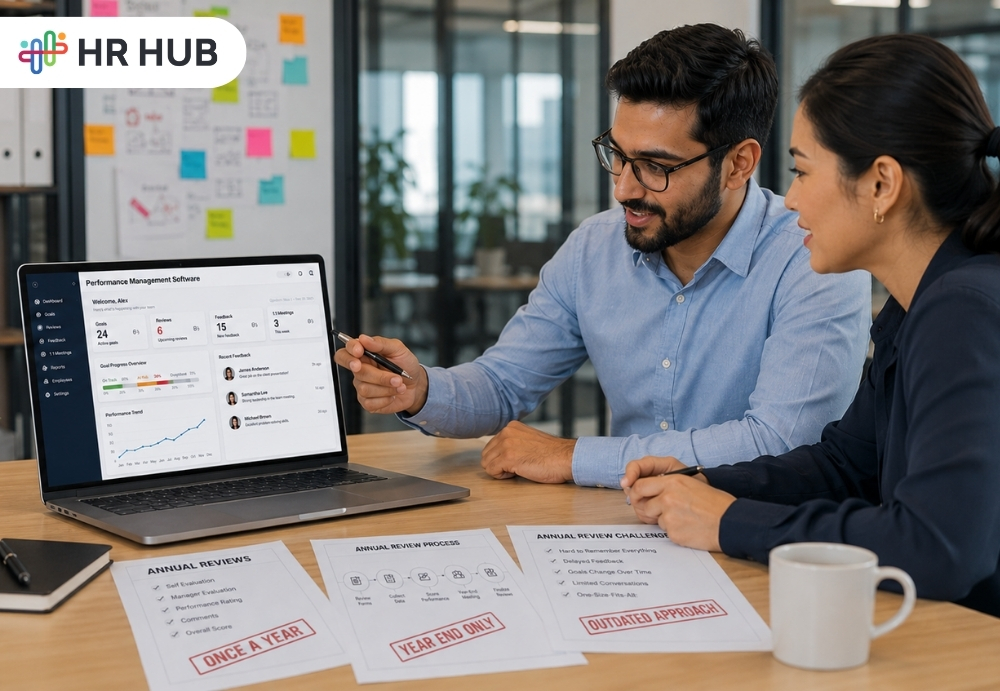
For decades, the annual performance review followed a familiar routine.
A manager opened a form, tried to remember an employee's work across the previous 12 months, assigned ratings, discussed goals, and closed the review until the following year.
The process looked organized. The timing was predictable. Everyone knew when appraisal season was coming.
But there was one major problem: work does not happen once a year.
An employee might complete an important project in February, struggle with a new responsibility in April, improve significantly by June, take on leadership responsibilities in September, and exceed a major goal in November.
Why should all of those moments wait until December for a meaningful conversation?
This is why organizations in the US and across global markets are reconsidering the traditional annual appraisal.
Harvard Business School has highlighted the move toward more frequent feedback, noting that regular conversations can make individual reviews feel less high stakes while giving employees more direction for career growth.
The shift is not about eliminating performance reviews altogether. It is about making performance management happen while performance is actually happening.
That is where performance management software becomes valuable. Instead of compressing an entire year into one conversation, organizations can maintain employee goals, reviews, feedback, performance information, and reporting throughout the year.
What Is Performance Management Software?
Performance management software helps organizations manage how employee goals, performance, feedback, appraisals, and development are recorded and reviewed.
Traditional performance appraisal software was often centered around one major event: formal appraisal. Modern systems have a much broader role. They can help HR and managers maintain a more structured performance cycle involving:
- Employee goals
- Performance objectives
- Periodic reviews
- Manager feedback
- Employee assessments
- Performance ratings
- Development discussions
- Performance reports and analytics
- Historical performance records
The objective is not to give employees a score more frequently. It is to create a clearer picture of performance over time. This distinction matters because employee performance management software should help answer questions such as:
- What is this employee currently working toward?
- How are they progressing?
- Where do they need support?
- What has changed since the previous conversation?
- What should happen next?
When these questions are discussed throughout the year, the final appraisal no longer has to reconstruct everything from memory.
Why Are Annual Performance Reviews Losing Their Appeal?
Annual reviews are not automatically useless.
For some organizations, a formal yearly appraisal still has a place. It can provide a structured point for documenting performance, discussing development, reviewing compensation decisions, or completing company-specific processes.
The problem appears when the annual review becomes the only meaningful performance conversation employees receive.
Consider what happens when feedback is delayed. An employee makes the same mistake repeatedly from March to September. The manager notices it but decides: "We'll discuss it during the appraisal."
By December, the employee has spent nine months without knowing that something needs to change. That is not really performance management. It is a performance history.
Problem 1: Twelve Months Is Too Much to Remember
Think about your own work last year.
- Can you remember exactly what you accomplished in February?
- What about every challenge you solved in May?
- Can you accurately compare your performance in March with your performance in October?
Probably not.
Managers face the same problem when reviewing employees.
This can create recency bias, where recent events influence the review more heavily simply because they are easier to remember.
An employee may have delivered excellent work for nine months, made one visible mistake shortly before appraisal season, and find that mistake dominating the conversation.
The reverse can also happen.
An employee with inconsistent performance may deliver one successful project immediately before the review and receive more favorable feedback than their full-year performance suggests.
Employee performance review software can help organizations maintain performance information throughout the year so managers have more context when formal review time arrives. Performance should be reviewed as a timeline, not reconstructed as a memory test.
Problem 2: Feedback Arrives After the Moment Has Passed
Useful feedback has a shelf life. Imagine an employee giving a client a presentation on Monday. Their manager noticed that the presentation was strong, but the financial explanation was confusing.
Which feedback is more useful?
Tuesday: The presentation was strong. Let's work on how you explain the financial section before the next client's meeting.
OR
Eight months later: Back in January, I think one of your presentations could have been clearer.
The first conversation gives the employee something they can do.
The second gives them history.
That is one of the strongest arguments for continuous performance management.
Frequent feedback does not necessarily mean formal reviews every week. It can mean shorter check-ins, goal discussions, coaching conversations, recognition, and periodic performance reviews throughout the year.
Problem 3: Employee Goals Change Faster Than Annual Reviews
Organizations change, then priorities change, sometimes projects change, after few times markets change and ultimately team's change.
Employee responsibilities change. Yet annual performance goals sometimes remain frozen for 12 months. An employee may begin the year with five objectives. By June, two are no longer relevant. A new strategic project has become their main responsibility.
By December, the manager is reviewing goals that no longer represent what the employee spent the year doing. Modern performance management software can give organizations a better way to maintain employee goals throughout the performance cycle. Managers and employees can revisit goals, monitor progress, and keep performance conversations connected to current responsibilities.
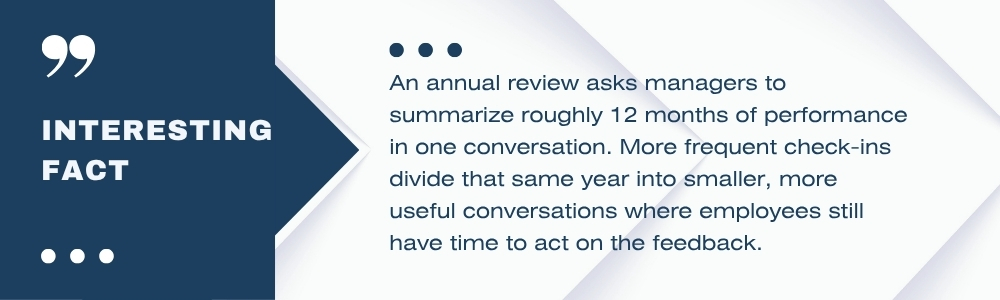
What Are Companies Doing Instead of Annual-Only Reviews?
Moving away from annual-only reviews does not mean companies are abandoning performance management. They are changing its rhythm.
Recent performance-management practices increasingly combine regular check-ins, current goal tracking, coaching, documented feedback, and lighter formal reviews. Some organizations use quarterly conversations, while others use monthly or project-based check-ins. The right frequency depends on the role, team, and business.
The common idea is simple: do not wait 12 months to discuss something that can be improved today. Modern continuous performance management may include:
- Monthly or quarterly manager check-ins
- Feedback after important projects or milestones
- Goals reviewed when business priorities change
- Employee self-assessments
- Development and coaching conversations
- Recognition when good work happens
- Periodic formal reviews supported by year-round records
This gives organizations more performance information without turning every conversation into an appraisal.
Some companies are also separating conversations that traditionally tried to handle all at once. Feedback, employee development, performance ratings, promotions, and compensation do not always need to happen in the same meeting. Current approaches increasingly treat the formal review as a summary rather than the only performance of conversation of the year.
Performance management software can support this approach by keeping goals, reviews, feedback, and performance history connected throughout the year.
Practical Performance Model Companies Can Use
There is no need to replace one complicated annual process with an equally complicated continuous one. Companies can start with a simple rhythm.
Monthly: Short Performance Check-In
A manager and employee spend a short period discussing:
- What has gone well?
- What is getting in the way?
- Has anything changed?
- What support is needed?
- What should happen before the next check-in?
This does not need to become another scored appraisal.
Quarterly: Goal and Progress Review
Every few months, managers can take a wider look at goals.
- Are the employee's objectives still relevant?
- What progress has been made?
- Should a goal be updated because business priorities changed?
- Are new skills or development needs appearing?
This is where employee performance software becomes useful because the manager can work from current goals rather than a document created months earlier.
After Major Work: Give Feedback While It Is Fresh
A major client presentation, product launch, completed project, difficult customer situation, or leadership responsibility creates a natural feedback moment. Do not save that conversation for December. Record meaningful feedback while the context is still clear.
Mid-Year: Look at the Bigger Picture
A more structured mid-year discussion can help managers identify patterns that may not appear during short check-ins. The employee and manager can review achievements, recurring challenges, development opportunities, and priorities for the rest of the year.
Year-End: Summarize, Don't Surprise
The formal appraisal can remain. But now it serves a different purpose. Instead of reconstructing 12 months from memory, employee performance review software can provide a record of goals, earlier discussions, progress, and performance information. The annual review becomes the summary of the year rather than the first serious conversation about it.
From Annual Appraisal to a Continuous Performance Cycle
The strongest alternative to annual-only reviews is not simply having more reviews. It is creating a repeatable performance cycle.
1. Set Clear Goals
The employee and manager agree on measurable expectations. Employees should understand what success looks like rather than discovering the criteria when they are being evaluated.
2. Track Progress
Goals should remain visible throughout the performance period. If responsibilities change, the goals should be reviewed too.
3. Check In Regularly
Managers and employees discuss progress, blockers, achievements, and support needs.
4. Give Feedback Close to the Work
Feedback becomes more useful when the employee still remembers the situation and has time to respond.
5. Recognize Strong Performance
Do not store every positive observation for appraisal day. Good work should be recognized when it happens.
6. Review Development Needs
Performance discussions should identify where coaching, training, mentoring, or new responsibilities could help the employee grow.
7. Update Goals
When company priorities change, employee goals should not remain frozen simply because they were entered at the beginning of the year.
8. Complete a Structured Review
A formal review can bring together information collected throughout the cycle.
Then the process starts again. This is where performance management software becomes more than a digital appraisal form. It helps maintain continuity between each stage.
What Happens to the Annual Appraisal?
Keep the annual review but give it a better job. Companies do not have to choose between annual reviews and continuous feedback. A hybrid model may be more practical.
Regular conversations can handle immediate feedback, changing priorities, coaching, and development. The formal appraisal can still provide structured documentation and a broader performance summary.
McKinsey's work on people-focused performance management similarly recommends regular performance conversations, including quarterly, weekly, or informal check-ins alongside formal reviews. It also emphasizes keeping goals flexible enough to change with business conditions.
In this model:
Continuous conversations answer: "What should we work on now?"
Quarterly reviews answer: "Are we progressing in the right direction?"
Formal appraisals answer: "What does the broader performance period tell us?"
This approach can be especially practical for companies that are not ready to remove their existing performance appraisal software process entirely. They can improve the process without rebuilding everything overnight.
Managers Need More Than Another HR Form
Software alone will not fix annual reviews. If managers do not know how to give useful feedback, asking them to hold more conversations can simply create more poor conversations. Companies moving toward continuous performance management should prepare managers to discuss performance clearly. A useful feedback conversation should be specific.
Instead of: "You need to communicate better."
Try: "During yesterday's client presentation, the project update was clear, but the timeline section left two questions unanswered. Before the next presentation, let's make the milestones more explicit."
The second version gives the employee context and something they can work on.
- Managers also need to distinguish between:
- Feedback: What happened and what could improve?
- Coaching: How can the employee develop?
- Recognition: What should be acknowledged?
- Goal discussion: What should the employee focus on next?
- Formal evaluation: How should performance across a defined period be assessed?
Separating these conversations can make employee performance review software more useful because every interaction does not have to become another rating.
Performance Data Should Support Decisions, Not Replace Judgment
Another way companies are strengthening performance reviews is by reducing dependence on a single manager's viewpoint. For some roles, organizations can include:
- Employee self-assessments
- Manager reviews
- Peer feedback
- Project-based feedback
- 180-degree or 360-degree reviews
- Goal achievement information
This does not mean every employee needs feedback from everyone. The approach should fit the role. A project manager who regularly works across departments may benefit from broader feedback. An employee working primarily with one supervisor may need a simpler review structure.
The goal is to create a better context.
Performance appraisal software can help organize these different perspectives, so the formal review is not based entirely on one manager trying to remember an entire year.
What Should Businesses Look for in Performance Management Software?
Changing performance management does not have to happen overnight. A company can introduce the new approach gradually.
Step 1: Review the Current Process
Ask managers and employees what is not working.
- Are reviews too late?
- Are goals forgotten?
- Do managers struggle to provide evidence?
- Do employees receive unexpected feedback?
- Do reviews feel disconnected from development?
Fix the actual problem rather than copying another company's review model.
Step 2: Choose a Realistic Check-In Rhythm
Do not immediately require weekly formal meetings across the entire company. A quarterly check-in may be enough for some organizations. Other teams may benefit from monthly conversations or project-based feedback. The cadence should match the work.
Step 3: Define What a Check-In Should Cover
Give managers a short framework rather than another lengthy form. For example:
Progress → Challenges → Feedback → Support → Next Priority
That keeps conversations focused.
Step 4: Make Goals Adjustable
Goals created in January should be allowed to change when the business changes. Modern employee performance software should help managers update objectives while preserving visibility into the employee's performance journey.
Step 5: Train Managers
Managers need to understand how to provide specific feedback, recognize good work, discuss difficult performance issues, and coach employees.
Step 6: Keep Useful Records
Not every conversation needs a three-page report. Capture the information that will matter later: major feedback, goal changes, achievements, development actions, and agreed next steps.
Step 7: Review the New Process
After several months, ask whether the new approach is actually helping.
- Are employees receiving feedback earlier?
- Are managers using the system?
- Are goals more current?
- Are year-end reviews easier to prepare?
If the answer is no, change the process. The purpose of continuous performance management is not to create more HR activity. It is to make performance conversations more useful.
Why This Matters for Global Organizations
For US and global organizations, consistency matters, but consistency does not always mean identical timing. A sales employee working toward monthly targets may need frequent goal conversations. A project team may benefit from feedback after major milestones. A senior leader may need quarterly strategic reviews. A new employee may need more frequent conversations during their first months.
The organization can maintain common performance principles while allowing the cadence to reflect the role.
For example, everyone might follow the same expectations around documented goals, timely feedback, development planning, and formal performance records while managers have some flexibility around when shorter check-ins happen.
This can make employee performance review software easier to adopt across different departments and countries.
Best Review Should Contain Fewer Surprises
A better performance review should feel familiar. Not because the employee already knows their rating, but because the important conversations have already happened.
- The employee knows their goals.
- They have received feedback.
- Good work has been recognized.
- Performance concerns have been discussed.
- Goals that became irrelevant were changed.
- Development needs have been identified.
The manager has performance information from across the year. When formal review time arrives, the conversation can focus on patterns, progress, development, and what comes next. That is one of the clearest signs that continuous performance management is working. A strong performance process should leave:
- Employees knowing where they stand
- Managers knowing where support is needed
- Goals connected to current priorities
- Development actions clearly recorded
- HR with more consistent performance information
- Leadership with better context for workforce decisions
- The goal is not to eliminate every annual meeting.
The goal is to make sure performance management happens during the other 364 days too.
Make Performance a Conversation, Not a Calendar Event
Your employees work toward goals all year. Their performance management should too.
HR HUB Pro brings Performance Management, PMS, Employee Goals, and Reports & Analytics together to help organizations create a clearer performance process beyond the once-a-year appraisal.
Set employee goals. Maintain structured performance cycles. Keep performance information available throughout the year. Review progress with better context. Use reporting to understand performance across your workforce.
Because by the time an employee hears important feedback 11 months later, the opportunity to act on it may already be gone.