

A new employee walks into the office for their first day.
HR has already prepared the employment documents. Their employee profile is being created. Payroll details are being checked. The manager has planned the first week of onboarding, and the employee is learning everything from where to sit to who approves leave.
Health insurance can easily feel like one more administrative task to finish after the employee settles in.
In the Cayman Islands, it should not be treated that way.
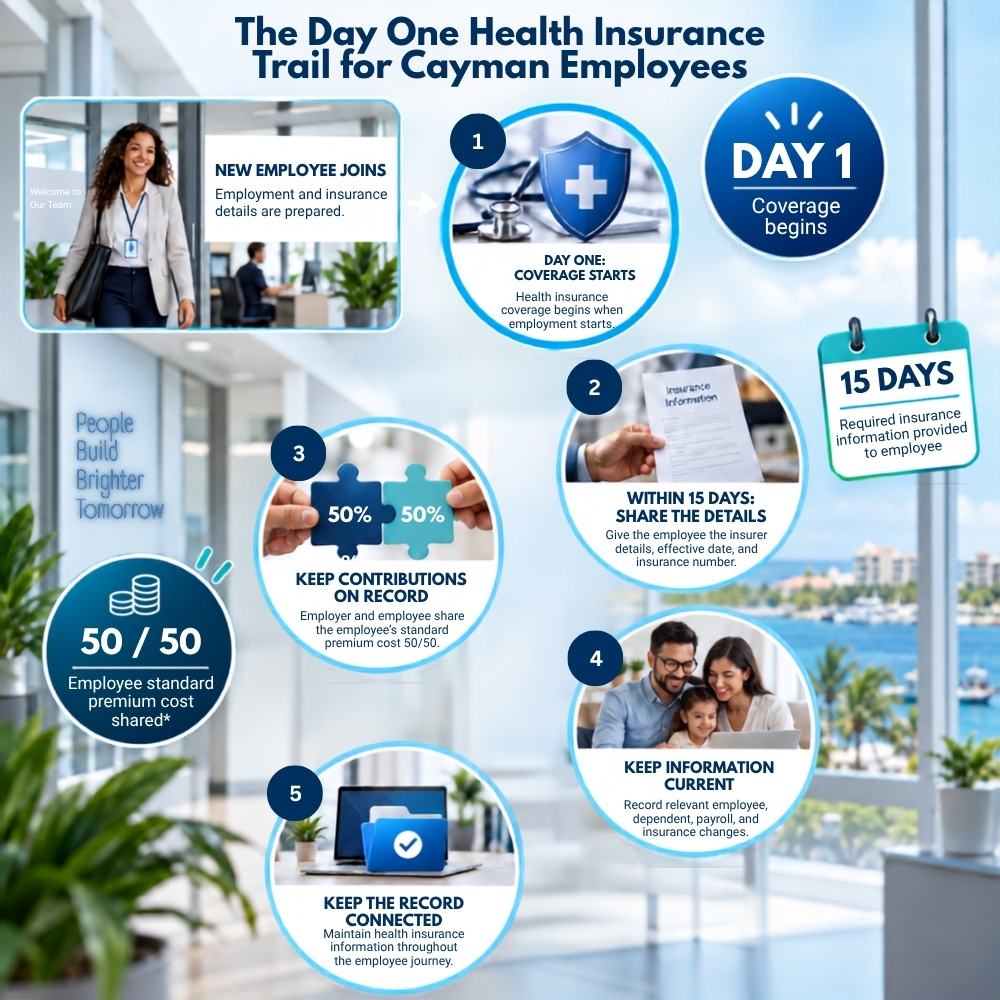
According to the Cayman Islands Health Insurance Commission (HIC), health insurance coverage commences on the first day of employment or as soon as the employee commences duties. The Commission also states that there is no requirement for an employee to complete a probationary period before receiving employer-provided health insurance coverage.
That makes Cayman health insurance compliance a Day One responsibility, not a task to revisit after onboarding.
And for HR, Day One is only the beginning.
Once coverage is arranged, the organization needs to keep the right employee information, communicate insurance details, manage payroll deductions, respond to changes involving dependents or circumstances, and maintain records that can explain what happened months later.
That is why Cayman Islands health insurance should be connected to the employee lifecycle rather than managed as an isolated insurance task.
Health Insurance Belongs on the Onboarding Checklist
Onboarding usually brings together many moving pieces. HR collects personal information. Banking details are added for payroll.
Policies are shared, documents are signed, and emergency contacts are recorded. Employees meet their teams and begin learning their roles.
Health insurance deserves a clear place in that process.
The HIC states that employers are responsible for providing health insurance for their employees through an approved insurer. Its current guidance also says coverage commences on the first day of employment or when the employee begins duties.
The Commission recommends having the employee complete the health insurance application when the employment contract is signed and submitting it to the approved insurer, so coverage starts when employment commences.
From an HR perspective, this makes employee health insurance Cayman administration closely connected with onboarding.
Instead of thinking: Employee starts → HR completes onboarding → Insurance gets handled later
The workflow should look more like: Offer Accepted → Employee Information Collected → Insurance Information Prepared → Coverage Starts with Employment → Records Maintained
This is a much safer foundation for Cayman health insurance compliance because the insurance process begins alongside employment rather than waiting for someone to remember it afterward.
Day One Coverage Does Not Mean Day One Paperwork Ends
Starting coverage is important, but employers also have an information responsibility after employment begins.
Under Section 11(1) of the Health Insurance Act (2021 Revision), an employer must, within 15 days after the employee starts employment, provide the employee with a written statement containing the name and address of the approved insurer, the effective date of coverage, and the insurance number of the health insurance contract.
This creates an important distinction. Coverage starts with employment. But there is also information that needs to reach the employee after commencement.
For HR teams managing employer health insurance requirements, that means onboarding needs more than a checkbox marked “insurance done.”
HR needs to know whether coverage was arranged, when it became effective, which insurer is providing it, whether the required information was given to the employee, and where the supporting record is stored.
This is where employee benefits compliance starts becoming a records problem as much as an insurance problem.
Managing these records becomes easier when employee information, documents, benefits details, payroll records, and notifications are connected within one HR system.
Insurance Record Needs to Follow the Employee
Imagine HR is asked three months after someone joined:
“When did this employee's health insurance become effective?”
The answer should not require searching through an inbox for an old message to the insurer.
A well-maintained employee record can help HR connect important information such as the employee's commencement date, insurer information, effective date of coverage, insurance number, relevant enrollment documentation, dependent information where applicable, and payroll-related contribution records.
This matters because Cayman health insurance compliance is easier to administer when the employment record and insurance information tell the same story.
If the employee's start date is in one system, insurance information is in an email, dependent details are in a spreadsheet, and deductions are only visible in payroll. Answering a simple question can become unnecessarily complicated.
For employee health insurance, Cayman administration, centralizing the relevant records gives HR a clearer view of what was arranged and what may still need attention.
Dependents Add Another Layer to Health Insurance Administration
Health insurance responsibilities do not necessarily stop employees.
The HIC states that employers are responsible for providing coverage for employees, an employee's unemployed spouse, and dependent children residing in the Cayman Islands. The HIC also explains that although the employer is responsible for the employee's coverage, the employer is not required to contribute toward premiums for the employee's dependents.
That creates another recordkeeping layer around Cayman Islands health insurance.
HR may need accurate information about whether relevant dependents exist, whether their circumstances have changed, and how the related premium arrangements affect the employee.
This is also why employee information cannot simply be collected once during onboarding and forgotten. A marriage, change in a spouse's employment status, addition of a dependent child, or another relevant change may affect the information the employer needs.
The Act specifically requires employees to keep their employer informed of facts relating to the employer's liability and changes in circumstances that would affect that liability.
For employee benefits compliance, keeping employee and dependent information current is therefore part of ongoing administration, not just new-hire paperwork.
Payroll and Health Insurance Records Need to Agree
Health insurance also reaches directly into payroll.
The Cayman Islands healthcare funding framework is designed so that the cost of an employee’s health insurance is shared between the employer and employee.
For the Standard Health Insurance Contract (SHIC), the employer is responsible for paying the premium to the insurer and may recover 50% of the standard premium cost from the employee’s salary, wages, or other remuneration.
In practical terms, this creates a 50/50 contribution arrangement between the employer and employee for the employee’s standard health insurance premium.
This makes payroll an important part of Cayman health insurance compliance. HR and payroll need to ensure that the correct employer contribution and employee deduction are recorded consistently and can be traced back to the employee’s active health insurance coverage.
It is also important to separate the employee’s premium from dependent coverage. While employers have responsibilities around providing coverage for eligible dependents, they are not required to contribute toward the cost of dependent premiums.
That makes accurate payroll records an important part of employer health insurance requirements.
When Employee Circumstances Change, HR Records Need to Change Too
The employee information HR collects during onboarding may be correct on Day One.
That does not mean it will remain correct forever.
This is an important part of Cayman Islands health insurance administration because the Health Insurance Act places an obligation on employees to keep employers informed about relevant facts and changes in circumstances that affect the employer's liability.
For HR, the practical challenge is what happens after the employee communicates that change.
- Was the update recorded?
- Does payroll need to change?
- Does the insurer need updated information?
- Does a dependent record need attention?
- Is there supporting documentation?
- Does anyone need a reminder to complete the next step?
This is where employee benefits compliance becomes easier when employee records, documents, payroll, and notifications are connected.
A change communicated in conversation but never reflected in the employee record can easily become tomorrow's discrepancy.
What If an Employee Refuses the Employer's Insurance?
This is another situation where documentation matters. The HIC states that every resident must have, at minimum, the Standard Health Insurance Contract.
If an employee refuses the coverage offered by an employer, the employer should document why the employee refused and seek to verify whether the employee has coverage from another source. If the employee does not have other coverage, the matter should be reported to the HIC.
That makes refusal more than a verbal: “No thanks, I already have insurance.”
From an employer health insurance requirements perspective, the supporting record matters.
HR needs to know what the employee communicated, whether alternative coverage was verified where appropriate, and what action followed.
That record can become important if questions arise later.
Termination Is Part of the Insurance Record Too
The employee lifecycle eventually reaches another important date: the last day of employment.
The HIC states that health insurance coverage terminates on the first day of the month following the termination of employment. If the former employee remains resident in the Cayman Islands and does not become insured through another employer, the employee can request continued coverage for up to three months, or until becoming employed, whichever comes first. In that situation, the employee is responsible for the full premium.
This means Cayman health insurance compliance also needs to connect with offboarding services.
HR may need a clear record of the termination date, relevant insurance communication, payroll deductions, any continuation request, and supporting documents.
For employee health insurance Cayman administration, a clean exit record is just as valuable as a clean onboarding record.
Otherwise, months later, HR may be trying to reconstruct when employment ended, what deductions were made, when coverage was expected to terminate, and what was communicated to the former employee.
Bigger Compliance Issue Is Often the Record Trail
There is a simple reason for Cayman Islands health insurance that fits naturally into HR software.
Insurance administration touches multiple parts of the employee's record. The employee's start date matters for managing multi-location worforces. Their personal and dependent information can matter.
- Documents matter.
- Payroll deductions matter.
- Changes in circumstances matter.
- Notifications and reminders matter.
- The termination date matters.
When each of these sits in a different spreadsheet, inbox, folder, or payroll file, HR must manually connect to the dots.
Centralized records do not replace the employer's legal responsibilities, the insurer, or the HIC. They can, however, make Cayman health insurance compliance easier to administer by helping HR keep the relevant employee information and actions connected.
That is particularly useful when employee benefits compliance needs to be demonstrated months after the original action took place.
Health Insurance Compliance Starts with the Employee, Not the Spreadsheet
A new hire's first day already comes with a long checklist.
Health insurance should not be the item waiting at the bottom.
In Cayman, coverage begins with employment, and the administrative responsibility continues as the employee's circumstances, payroll, dependents, documents, and eventually employment status change.
Strong Cayman health insurance compliance therefore is not simply about arranging a policy once. It is about maintaining the employee record around that policy throughout the employment journey.
HR HUB PRO helps bring Employee Information, Documents, Payroll, Benefits Records, Notifications, and Onboarding into a more connected HR process.
So when a new employee walks through the door, HR does not have to wonder: “Did we remember the insurance?”
The better question becomes: “Is everything that needs to happen from Day One clearly recorded, connected, and ready for the next step?”
With HR HUB PRO, turn health insurance from a scattered onboarding task into a connected part of the employee journey, because compliance is easier to manage when the record starts on Day One too.