

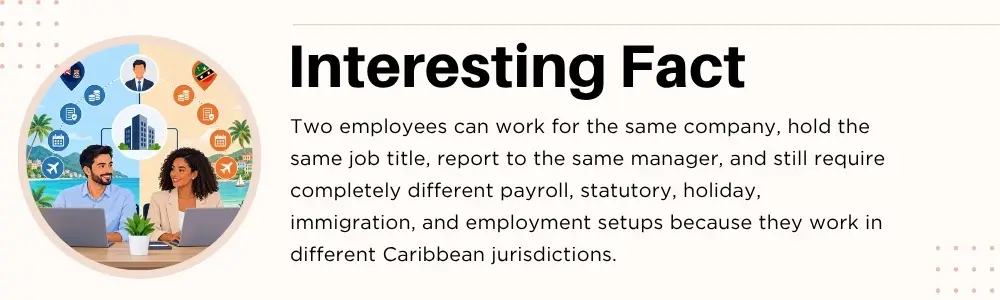
A company can have one leadership team, one brand, and one set of business goals while its employees work across five different islands.
That sounds like growth.
For HR, it can also mean five different operating realities.
One employee may be paid in Jamaican dollars. Another may work in a territory using Eastern Caribbean dollars. A third may need a work permit renewal. Public holidays differ. Payroll deductions differ. Employment rules differ. Documents that are essential in one jurisdiction may not even exist in another.
The challenge is therefore not simply managing people remotely.
It is maintaining one reliable view of the workforce without pretending every Caribbean location works the same way.
This is where global HR management software becomes useful. It can centralize employee identities, reporting relationships, and employment histories while supporting country-specific payroll, currency, immigration, leave, and compliance requirements.
The principle is simple: Standardize what belongs to the company. Localize what belongs to the country.
That is how a regional business can grow across borders without losing HR visibility.
Start With One Regional Source of Employee Information
Cross-border complexity becomes much harder when every island maintains its own version of employee information.
- The Jamaica team has one spreadsheet.
- Trinidad has another.
- The Barbados office keeps additional records.
Regional management maintains its own list.
Payroll has another file. The information may all be individually correct, but the organization no longer has one reliable answer to a basic question:
Who currently works for us?
A region-capable HRIS should become the common employee layer behind the business. That does not mean replacing every local process with one rigid workflow. It means maintaining a consistent employee identity containing information such as:
- Employee ID
- Job Title
- Department
- Manager
- Employment Status
- Work Location
- Compensation Details
- Contracts
- Leave Information
- Employment History
- Important Documents
This is the foundation of global employee management. If someone moves from Jamaica to Cayman, their employee history should not disappear simply because their country configuration changes.
The person remains one employee. The employee remains the same, but the local HR requirements applied to their employment change. That is also why good multi country HR software should separate the employee's core record from the local rules applied to that record.
Centralization HR System Does Not Mean Making Every Island Identical
This distinction is important. A company might want every employee to record to follow the same basic structure.
That is reasonable, but it does not mean every payroll, leave rule, statutory contribution, or employment policy should also be identical.
The Caribbean is not one employment jurisdiction.
Official sources illustrate how quickly these differences appear. Barbados has its own National Insurance contribution structure, Saint Lucia administers its own National Insurance Corporation requirements, while Trinidad and Tobago employers also operate under PAYE withholding requirements and their own National Insurance framework.
A useful Caribbean HR software strategy therefore needs two layers:
- Regional Standard: Who the employee is and how the company structures HR.
- Local Configuration: How payroll, tax, statutory contributions, leave, immigration, and compliance operate in that jurisdiction.
That separation makes international workforce management much more practical.
Multi-Currency Is More Than Showing a Currency Symbol
A Caribbean group may encounter several currencies across its workforce. For example:
- XCD for businesses operating in Eastern Caribbean Currency Union markets
- JMD in Jamaica
- TTD in Trinidad and Tobago
- USD in some business arrangements and jurisdictions
- Along with other local currencies such as Cayman Islands dollars or Bermudian dollars
At first glance, multi-currency support sounds like a payroll feature. It has a wider impact. Consider a regional executive asking:
“What does our workforce cost across the Caribbean?”
Looking at a collection of raw salary figures will not answer that question properly unless the system also understands which country and currency each figure belongs to.
Good global HR management software should therefore maintain the context behind compensation. The useful relationship is:
Employee → Country → Currency → Salary Structure → Local Payroll Rules
That structure helps local payroll teams work accurately while giving regional leadership better visibility into workforce costs.
Choose the Right Payroll Model for Each Country
How payroll is managed may also depend on how the company operates in a particular market.
If the organization already has a registered local entity, it may use an appropriate local payroll provider or country-specific payroll setup connected with its wider HR environment. If it does not have a legal entity in a particular territory, an Employer of Record may be considered.
An EOR legally employs workers locally on behalf of the business and can support areas such as payroll, statutory deductions, benefits, and employment administration.
Whichever model is used, the wider global HR management software environment should still help HR understand:
- Who works where?
- Which payroll setup applies?
- Which currency is used?
- Which local requirements need attention?
This prevents regional payroll from becoming a collection of disconnected processes.
Immigration Cannot Sit in a Separate Spreadsheet Forever
For many Caribbean employers, cross-border workforce management also means immigration management. Foreign employees may have:
- Work Permits
- Visas
- Renewal Dates
- Sponsorship Details
- Supporting Documents
- Application Statuses
- Expiry Dates
These records are not simply administrative attachments. They can affect whether an employee can legally continue working in a particular location. Now imagine the company operates across several islands.
One employee's work permit expires in Cayman next month.
Another employee has a renewal pending in Bermuda.
Someone else has supporting documentation due for an immigration process in another territory. This is where global employee management needs to connect the person with their local immigration status.
The Immigration Management module is designed around work-permit and visa records, renewal reminders, document storage, renewal tracking, and a multi-island compliance dashboard.
This is also where Caribbean HR software has a different responsibility from a generic employee database. The employee profile needs to reflect not just who the person is, but the employment and immigration context attached to the island where they work.
Keep Documents Connected to the Employee
Cross-border employment creates plenty of documentation. Contracts, permits, identification, salary letters, certifications, policy acknowledgements, and country-specific records can quickly accumulate.
Simply putting them into cloud storage does not automatically create good global employee management. HR still needs to know:
- Which employee does this belong to?
- Which country does it apply to?
- Is it the latest version?
- Does it expire?
- Who should have access to it?
A centralized document structure becomes especially valuable when employees move between countries.
Their historical records stay available while current documents remain clearly linked to their new location. This is another area where multi-country HR software can reduce fragmentation.
What Should Be Standardized Across Countries?
Not everything needs local customization. Some parts of HR benefit from remaining consistent across the entire business.
Employee Structure
HR can use a common approach for names, employee IDs, departments, designations, reporting relationships, and employment status.
Employee Lifecycle
Joining, transfer, promotion, salary revision, and termination can follow a common organizational framework even if the required documents differ locally.
Document Organization
Countries may require different documents, but the organization can still follow a consistent process for storage, access, expiry alerts, and history.
Reporting Structure
Leadership can use common definitions for headcount, active employees, turnover, workforce distribution, and organizational structure.
Access Control
Regional managers should see what they need without automatically gaining access to every employee's record across every country.
This is where global employee management benefits from consistency.
People across Cayman and Jamaica may follow different payroll rules, but HR does not need two completely unrelated methods for identifying departments or storing employment history.
What Should Be Central and What Should Stay Local?
The easiest way to think about regional HR is to divide it into two layers.
Centralize
- Employee Information
- Reporting Structure
- Employment History
- Core Company Policies
- Document Organization
- Access Controls
- Regional Reporting
Localize
- Payroll Calculations
- Currency
- Statutory Deductions
- Labor-law Requirements
- Immigration
- Public Holidays
- Country-specific policies
That is the balance a strong multi-country HR software strategy should support. It also gives global employee management a clearer purpose: maintaining one understandable employee journey even when the local rules around that person change.
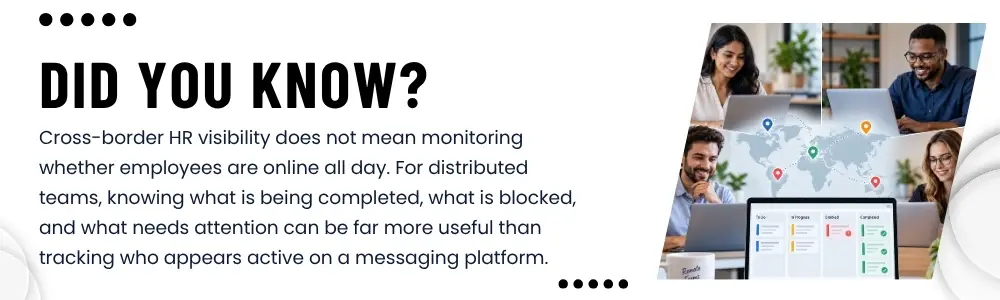
Visibility Should Not Mean Watching People All Day
Cross-border management often creates another temptation: measuring visibility by online presence.
- Who is green on Teams?
- Who replied immediately?
- Who appeared in the morning call?
- Who was online at 5 PM?
That is not necessarily useful workforce visibility. For distributed teams, managers often learn more from visible work and predictable communication than from constant presence monitoring.
This is why an async-first operating model can complement global HR management software.
HR technology can answer:
- Who is employed?
- Who is on leave?
- Where are they based?
- Which documents are expiring?
- What payroll setup applies?
Project and collaboration tools can answer:
- What is the team working on?
- What was completed?
- What is blocked?
- What happens next?
Tools such as Asana, Jira, or Monday.com can make tasks and deliverables visible without requiring managers to constantly ask for progress.
Slack or Microsoft Teams can support structured updates such as:
- What did I complete?
- What am I working on next?
- What is blocking me?
This creates operational visibility without turning international workforce management into digital micromanagement.
Cloud Access Matters When HR Is Not Sitting Beside the Employee
Regional HR also needs to consider where the workforce actually works.
- A manager in Cayman may need information about an employee in Jamaica.
- An employee travelling between islands may need access to documents.
- A regional HR director may be working remotely.
- A local manager may need information outside normal office hours.
This is one reason cloud-based, mobile-friendly systems are particularly practical for multi-country HR software. The aim is not simply to put the HR database online.
The useful outcome is that authorized people can access current information without waiting for someone in another country to email a spreadsheet.
This also matters in environments where connectivity can vary. Simple, mobile-friendly experiences are often more useful than complex desktop-only HR interfaces.
Bring Your Caribbean Workforce Into One Clearer View
As your organization expands across Caribbean jurisdictions, separate spreadsheets, payroll files, immigration trackers, and document folders can make HR visibility increasingly difficult.
A regional workforce should not require regional leaders to chase spreadsheets across several islands.
HR HUB PRO connects employee information, payroll and compliance, immigration records, documents, leave, attendance and reporting within one Caribbean-focused HR suite. Explore the relevant modules or book a demo to discuss the countries and workforce processes your organization needs to manage.
With HR software designed for multi-country Caribbean operations, HR teams can maintain centralized employee visibility while supporting the local requirements that make each jurisdiction different.